


DOG LEASHES: WHAT TYPE DOES YOUR DOG ACTUALLY NEED?
A guide to clasps, lead styles, no-pull harnesses and choosing the right gear for your dog's behaviour and your lifestyle
Leash clasps fail. It does not happen often, but when it does, it is frightening — and it almost always comes down to one of two things: the clasp has not been matched to the dog's weight and behaviour, or it has not been maintained.
Understanding why clasps fail — and how to choose the right one from the start — is one of the most practical things a dog owner can know. A clasp that is right for a small calm dog may not be right for a large dog that pulls hard on every walk — because it is the combination of your dog's weight and their behaviour that determines how much force is placed on the hardware. A clasp that has spent years exposed to salt water, sand or moisture without being cleaned or maintained will eventually fail regardless of how well-behaved the dog is. Neither of these is a manufacturing fault. Both are entirely preventable.
This guide covers leash clasps, lead styles, no-pull harnesses and how to match your gear to your dog's actual behaviour and lifestyle — so you can walk with confidence and choose equipment that does its job every single time.
UNDERSTANDING LEASH CLASPS — THE MOST IMPORTANT CHOICE YOU WILL MAKE
Most people choose a leash based on how it looks. The clasp is almost an afterthought. But the clasp is the single critical connection point between you and your dog — and according to industry analysis, leash clasps are the failure point in approximately 73% of leash incidents. They are not all created equal, and choosing the wrong one for your dog's behaviour is the most common mistake dog owners make.
Standard Bolt Snap Clasp

The most common clasp on the market. A spring-loaded bolt that opens when you press the trigger and snaps shut when released. Lightweight, easy to use and reliable for the vast majority of dogs. As Zoetis Petcare notes, standard bolt snap clasps work well for smaller dogs or those that do not pull on the lead — however, larger dogs or those that pull can bend or break these clips, and with extended use the spring can weaken so the bolt may not close completely.
The key issue is not the clasp's static strength but what happens when a dog lunges. Published research in the Annals of Biomedical Engineering recorded peak pulling forces of over 412 Newtons during routine walks, with loading rates of nearly 2,900 Newtons per second during lunging events. That is an enormous spike of force delivered in a fraction of a second — far beyond what a standard spring-loaded mechanism was designed to handle repeatedly. Think of it like bending a metal paperclip back and forth. The metal is not weak, but repeated stress at the same point will eventually cause it to fail.
Lobster Claw Clasp (also called a Crab Claw Clasp)

A variation on the bolt snap with a lever-operated gate that opens sideways. Generally considered slightly more secure because the gate is harder to accidentally open. Similar strength characteristics and the same principles apply — excellent for calm walkers and everyday use, but not designed for dogs that pull hard and repeatedly.

Carabiner Clasp
A completely different category. Carabiners originated in rock climbing, where hardware failure is simply not an option. They work by screwing or twisting shut or pulling up and down to shut rather than relying on a spring mechanism, which makes them far more resistant to repeated dynamic stress and much harder to accidentally open. Quality carabiners rated for dog leash use typically offer breaking strengths from around 390kg (860lbs) up to well over 1,200kg (2,700lbs) depending on the model — significantly higher than standard or lobster claw clasps. For dogs that pull hard and consistently, a carabiner clasp leash is the appropriate choice.
The critical point: Choosing the right clasp comes down to a combination of your dog's weight AND their behaviour on the lead. A tiny dog that pulls frantically will never generate enough force to break a standard clasp — their body weight simply cannot produce that level of pressure. A large or giant breed that lunges suddenly is a different matter entirely, even if they are generally well-behaved — their body weight alone can create significant force in a single unexpected lunge. And a medium-sized dog that pulls constantly and maniacally? That is arguably the highest risk scenario of all. The sweet spot for clasp failure is not the biggest dog or the worst-behaved dog in isolation — it is the combination of meaningful body weight AND significant pulling behaviour. This is why Blog 2 of this series will include specific weight and breed guidance for every leash in the Hendricks & Maple range based on actual hardware stress testing — so you can choose with complete confidence.
WHY LEASH CLASPS FAIL — AND HOW TO PREVENT IT
When a clasp fails on a dog that pulls, it is usually not a manufacturing defect. It is usually a mismatch between the equipment and the forces being placed on it. As the Preventive Vet notes, strong dogs that pull on lead can bend or break standard clips — and over time, the spring weakens so the bolt may not stay closed correctly.
Beyond pulling behaviour, maintenance is a significant and often overlooked cause of clasp failure. Industry guidance advises that in coastal or saltwater environments, clasps should be checked monthly for signs of pitting, stiffness or corrosion. Dirt, sand and salt deposits work their way into spring mechanisms and cause them to seize or weaken. Clasps used for beach walks, boating, swimming or any salt or sand exposure need regular cleaning and occasional lubrication to remain reliable. High-use leashes may need hardware replacement every 12 to 18 months regardless of visible wear. Inspect clasps every few months — and replace at the first sign of stiffness, corrosion or incomplete closure.
The solution to a clasp that keeps failing is not to find the same type of clasp from a different brand. It is to identify whether the clasp type is right for the dog's behaviour, whether the environment has caused corrosion or wear, and whether it is time to move to a carabiner.
TRAINING YOUR DOG NOT TO PULL — THE REAL SOLUTION
No piece of hardware is a permanent substitute for training. If your dog pulls on the lead, the right long-term answer is to teach them not to.
Loose leash walking is one of the most achievable things you can work on with your dog. The most effective method is simple and consistent: the moment the lead goes taut, you stop. You do not move forward. You wait. When the lead goes slack, you walk again. You change direction when your dog forges ahead. You make it clear — every single time, without exception — that pulling does not get them where they want to go.
It takes patience. It takes consistency every walk, not just occasionally. And it works.
A carabiner clasp keeps you and your dog safe during the training process. But the goal is always a dog who walks calmly beside you on any leash, with any clasp.
NO-PULL HARNESSES — WHAT THEY ACTUALLY ARE AND HOW THEY WORK
The term "no-pull harness" is used widely across the pet industry and causes a great deal of confusion. Here is what it actually means — and what it does not mean.
A no-pull harness is simply any harness that has a D-ring attachment point on the chest, at the front. That is the only functional difference between a no-pull harness and a standard back-clip harness. There is no design feature that physically stops a dog from pulling. The front D-ring is a training aid — not a miracle solution.
Why the front D-ring works
When a dog pulls forward on a standard back-clip harness, the force goes straight ahead — exactly where they want to go. In fact, as Victoria Stilwell's Positively notes, a back-clip harness can actually help a dog pull more efficiently, in the same way a sled dog harness is designed to do.
When the leash is attached to the front chest D-ring, something different happens. As the dog moves forward and the lead goes taut, the attachment point steers them sideways and back toward you, interrupting the pulling motion and creating a moment of redirection. That moment is your training opportunity. You turn them back, you reward the check-in, you continue. Over time, with consistency, the dog learns that pulling does not get them where they want to go.

Using a no-pull harness correctly
For a front-clip (NO PULL) harness to work, you must clip the leash to the front D-ring. This sounds obvious but it is the single most common mistake — owners purchase a no-pull harness and attach the leash to the back ring out of habit, which completely defeats the purpose.
Some owners use a double-ended lead that clips to both the front D-ring and the back D ring simultaneously. This can give greater control during training while distributing pressure more evenly — useful particularly for stronger dogs.
The harness creates the opportunity. Consistent training makes it permanent.
A word of caution on harness design — this matters more than most people realise
There is one harness design that genuinely does reduce pulling — but not in a good way, and not safely. Some harnesses marketed as no-pull feature a straight horizontal strap that sits across the front of the dog's chest and shoulders. This strap physically interferes with the dog's natural shoulder movement on every single stride. The dog pulls less not because they have been redirected or trained, but because the harness is actively preventing them from moving properly.
This is not training. It is physical restriction — and the consequences for your dog's long-term health can be serious.
The shoulder blades of a dog are not fixed like a human's. They slide back and forth along the ribcage with every step, enabling their natural stride. When a horizontal strap sits across the shoulder joint, it blocks this essential movement on every stride, every walk, for as long as that harness is worn. Research published in peer-reviewed veterinary journals confirms that harnesses whose straps cross the shoulder joint interfere with shoulder extension and can over time contribute to shoulder muscle injury, degenerative joint disease and osteoarthritis.
More seriously — veterinary rehabilitation specialists specifically warn against any horizontal strap that cuts across the front of the elbows or shoulders, noting that important nerves and blood vessels supplying the legs run through the armpit area. Pressure or friction in this region from an ill-fitting or poorly designed harness can cause nerve compression or damage, manifesting as pain, numbness or changes in the way your dog moves — and in serious cases, muscle damage and nerve irritation in this area can lead to paralysis.
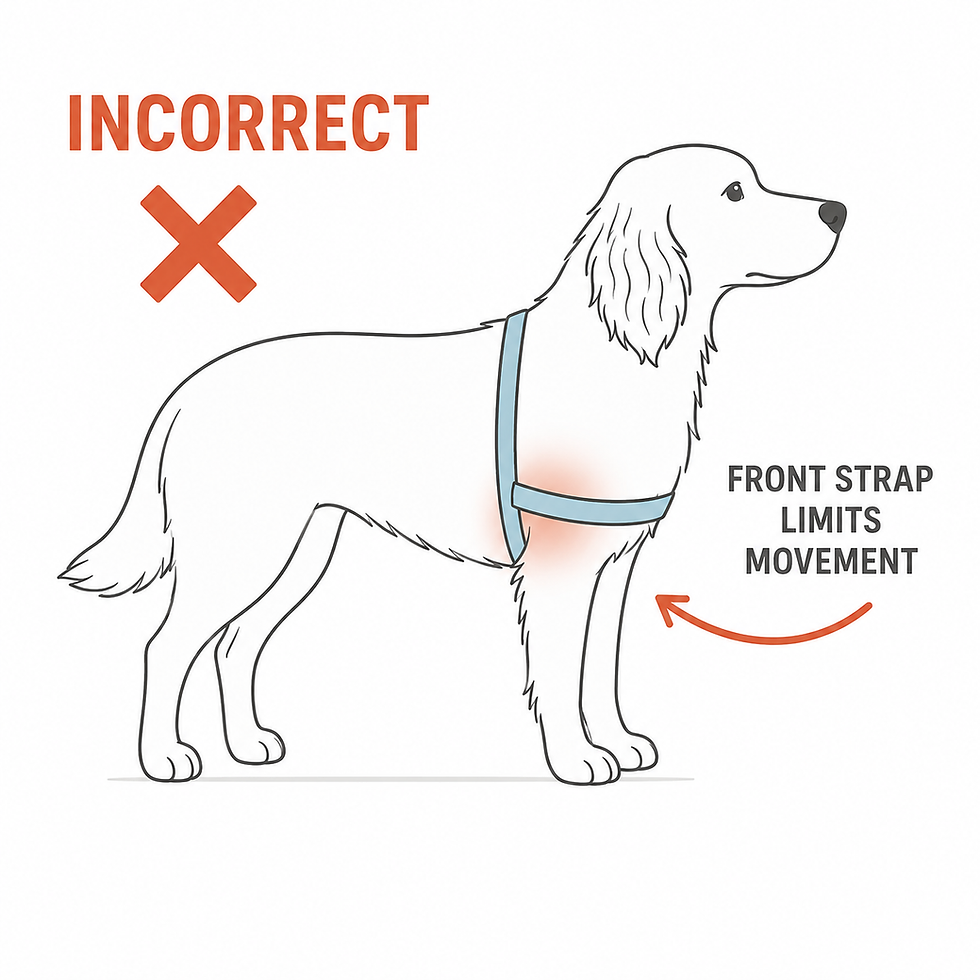
If your dog's harness has a straight horizontal strap across the front of the chest that sits at or below the shoulder joint — replace it. A correctly designed harness has a Y-shaped or curved front piece that sits in the centre of the chest, well clear of the shoulder joints, leaving the shoulder blades completely free to move naturally. The front D-ring does the training work. Your dog's body should move freely.
This is of particular concern for breeds already predisposed to spinal conditions such as IVDD — including Dachshunds, French Bulldogs, Corgis and Basset Hounds — where any disruption to natural gait and spinal loading caused by an ill-fitting or poorly designed harness may place additional stress on already vulnerable discs. Cornell University College of Veterinary Medicine notes that lifestyle and environmental factors contribute to overall IVDD risk alongside genetics. For these breeds especially, harness design is not a trivial choice.
If you are unsure whether your dog's harness is affecting their gait, watch them walk toward you without it, then with it. Any shortening of stride, stiffness in the front legs or change in the way they carry their head is a sign the harness is interfering with natural movement. Consult your veterinarian or a canine rehabilitation specialist if you have concerns.
CHOOSING THE RIGHT LEAD STYLE FOR YOUR LIFESTYLE
Once you have matched the clasp to your dog's weight and behaviour, the style and length of lead comes down to how and where you walk together.
Standard leads — 120cm to 150cm
The everyday lead for most dogs and most situations. Short enough to maintain control in busy environments, long enough to give comfortable freedom on a regular walk. Available in cotton rope, braided cord, jacquard fabric, printed neoprene, denim and leather. For calm dogs in everyday settings, a standard length lead is almost always the right choice.

Multi-function leads — 230cm
A longer lead with clasps at both ends opens up multiple configurations: standard lead, hands-free worn across the body, double-ended training lead attaching to both harness D-rings, or a temporary tether. Particularly useful for active owners, hikers and anyone who needs their hands free on a walk. Worth noting: hands-free walking is best suited to dogs with solid leash manners, as a dog that pulls can unbalance you when the lead is attached around your body.

Rope leads
Cotton rope leads are soft in the hand and offer a small amount of give that can help absorb sudden movement — a good option for long daily walks. Comfortable for handlers who cover longer distances.

Cord leads
Braided polyester cord is particularly soft to hold, making it a good choice for owners with sensitive hands or those who find standard webbing uncomfortable over longer walks.

Fabric, printed neoprene and leather leads
Printed neoprene is highly durable and easy to wipe clean — ideal for beach walks, water activities or dogs that wade into mud. Jacquard, denim and leather leads are best suited to drier conditions and are perfect for cafes, markets and occasions where you want something beautiful. A quality leather lead will soften and improve with use and can last many years with proper care — but avoid salt water and sand exposure without regular maintenance.

QUICK REFERENCE GUIDE
Your dog... | Clasp to use | Lead to consider |
Calm walker, any size or breed | Standard or lobster claw | Any style you love |
Occasional puller | Standard or lobster claw | Rope or cord — some give helps |
Consistent hard puller | Carabiner — essential | Strong webbing or adventure lead |
In training for pulling | Carabiner + front D-ring harness | Double-ended or 230cm multi-function |
Active / hiking / trail dog | Carabiner recommended | 230cm multi-function or adventure lead |
Hands-free walking or running | Standard clasp (calm dogs only) | 230cm multi-function lead |
Beach or salt water environment | Any clasp — but inspect and clean regularly | Neoprene or rope — easy to rinse |
THE BOTTOM LINE
Choose the clasp that matches both your dog's weight and their behaviour on the lead — because it is the combination of the two that determines how much force your hardware will face. Maintain your hardware regularly, especially if you walk near the beach, in salt air or through sand and mud. Use a no-pull harness correctly by clipping to the front D-ring every time, and pair it with consistent training. Choose the lead style and length that suits how you actually walk together.
And if your dog pulls? Work on it. A carabiner clasp keeps everyone safe while you do. The leash is the tool that gives you the opportunity. Training is what actually solves the problem.
Coming soon — Part 2: The Hendricks & Maple Leash Hardware Guide. We are currently stress-testing the hardware on every leash in our range to give you a specific guide by breed, weight and pulling behaviour so you can shop with complete confidence.
Questions about which leash is right for your dog? DM us on Instagram @hendricks_and_maple or email hendricksandmaple@gmail.com
🍁 Browse our full leash range at https://www.hendricksandmaple.com/dog-leads-dog-leashes


Comments