


How to Measure Your Dog: The Right Way to Get Sizing Right Every Time
Updated: Aug 5
If you've ever ordered a harness or jumper that looked perfect online and then didn't fit right at all, you're not alone — and it's very rarely bad luck. Nearly every fit problem comes down to one of a few common, fixable mistakes, and one big misconception sits behind most of them: a "small" dog does not automatically mean a size "Small." Size labels only describe where a product sits within that particular range — smaller than a Medium, bigger than an XS — not a fixed real-world size that applies across every brand, or even every product.
The mistakes most people make
The most common sizing mistakes are:
Not measuring at all — guessing or assuming based on breed instead.
Measuring in the wrong places.
Measuring the wrong way.
Not adding extra length for comfort.
Not sizing up when a measurement sits close to the edge of a size range.
Not buying a properly adjustable harness in the first place.
Pet sizing isn't standardised across the industry — and this is the part people misunderstand most. A "small" dog does not simply wear "size Small." That label only tells you where a product sits within its own size range, not how it compares to your actual dog.
A size Small from one brand won't necessarily match a size Small from another — and even within the same brand, sizing can vary between different product styles. That's why measuring your own dog and checking it against the specific product's size chart matters more than going off a size label of something you bought that fits, or your dog's breed, alone.
We sometimes mention that a particular breed tends to fit a certain size well, since it can be a useful starting point. But that's all it is — a starting point, not a guarantee. Sizes vary so much even within a single breed that your dog's actual measurements should always win out over any general breed suggestion, ours included. its also why when you email and ask "What harness fits my Yorkie?" we really need their measurements to give you a response.
How to measure your dog: step by step
Measure your dog's chest (around the widest part, just behind the front legs) and their neck (where a collar would normally sit). Then add 3cm to both measurements — this allows room for comfort rather than a tight, restrictive fit. See the diagram below for exactly where each measurement is taken.

When you check your measurements against a size chart, aim for the middle of the size range where possible. If your dog's measurement sits close to the edge between two sizes, size up rather than down.
A fully adjustable harness — adjustable at both the chest and the neck, not just one — matters more than people realise. It's especially important for what we call an "ODD BOD" dog: one with a small neck relative to a larger chest. If you buy a harness sized to fit the chest but the neck can't be adjusted down, it will gape open at the front and never sit comfortably. Our Donut Eat My Donuts Pink Donut Adjustable Step-In Style Dog Harness is one example, available in sizes XXS–L.
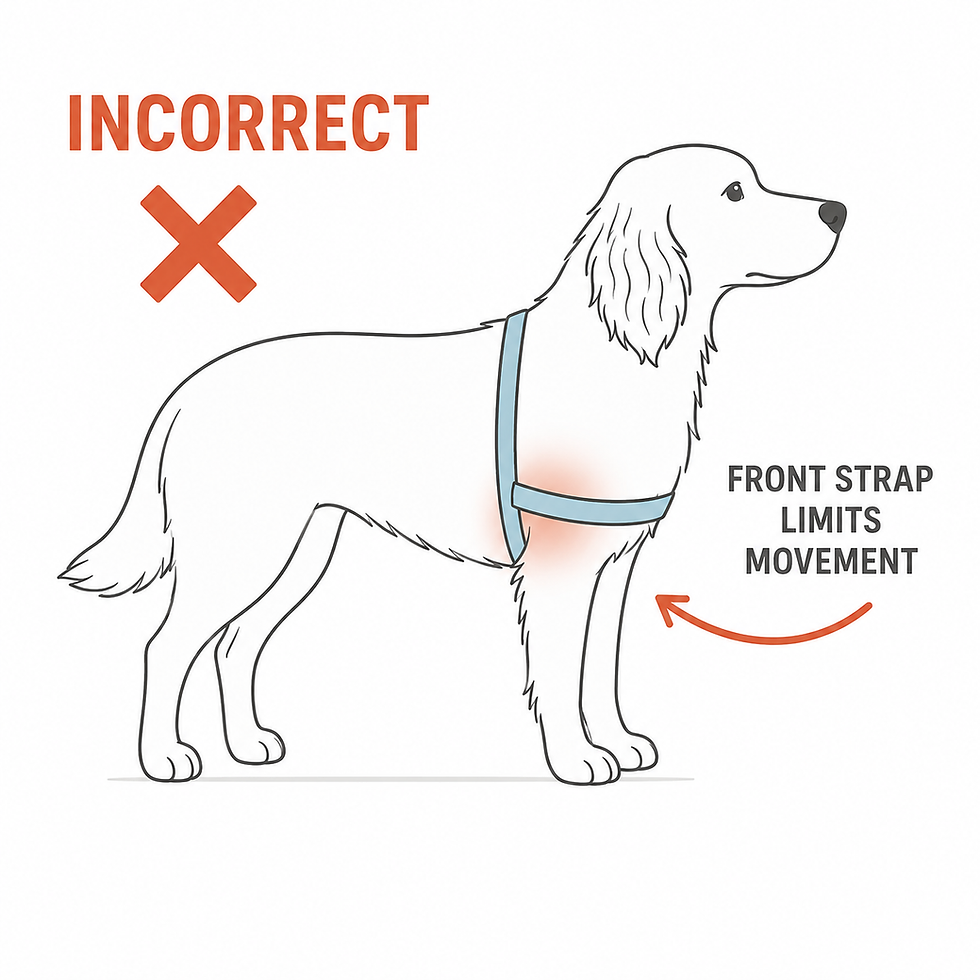
Worth knowing: one of the most popular harness trends at the moment uses a strap that sits straight across the chest, often dressed up with a velcro name patch. Research backs up the concern here — one study found this style of harness reduced a dog's natural shoulder extension by up to 80% at walk and trot, compared to around 10% for a Y-shaped design, because the strap sits directly over the mobile part of the shoulder blade and blocks the front leg's forward reach. Over time, that restriction can shorten a dog's stride and put ongoing strain on the shoulder joint. A harness should allow free movement of the legs, not sit across them
Long-bodied breeds have their own particular fit challenge worth knowing about too. Generally, we find adult Miniature Dachshunds fit our size Medium harnesses without any issues — but if you've found standard harness lengths a little short and causing chafing in the armpits, our HERITAGE Range adventure harnesses are deliberately made with longer chest pieces, designed with Dachshunds, Whippets and other long-bodied breeds in mind.

Watch the full walkthrough on the technique here: How to Measure Your Dog — Part 1
Front and back length: for clothing, not just harnesses
Chest and neck measurements aren't the whole story once you're shopping for jumpers, coats or anything with body coverage — length matters too.
Your dog's back length is a useful guide (shown in the same diagram above): compare it to a garment's stated length to judge whether it will sit well on their body, not just fit around it. Front length (measured from the collar on the front of the chest, between the legs and down the underside of the belly) is worth knowing too, especially for male dogs — it tells you whether something that's a great length on the back will end up too long at the front.
Full walkthrough here: How to Measure Your Dog — Part 2
A simple habit worth building: keep a record of your dog's measurements by texting them to yourself. That way, whenever you spot something you like, you can check it against your dog's actual numbers on the spot rather than guessing from memory.
Once you've got the size right: how to actually put it on
Getting the size right is only half the job — some pieces also take a bit of technique to put on smoothly, especially anything that goes over the head.
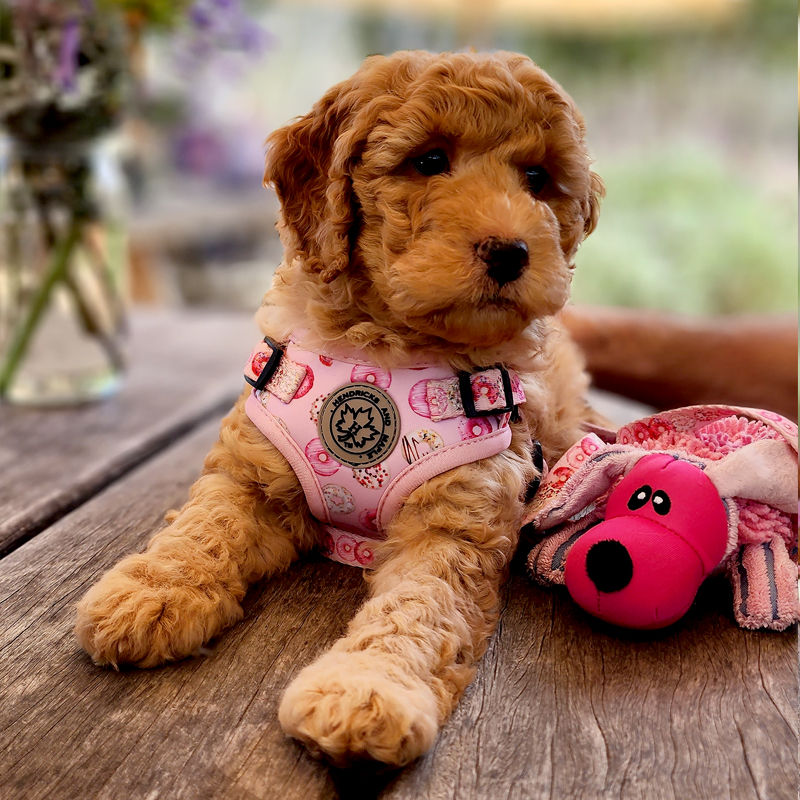
For a harness specifically, once you've got the right size, putting it on and adjusting it correctly matters just as much. The Hendricks and Maple round logo always sits at the front of the harness, on your dog's chest — the straps and handle are at the back. This can get confusing with NO PULL harnesses, since they often have a D-ring at both the front and the back. There should always be a D-ring at the back of any harness. If your NO PULL harness also has a front D-ring, the front is simply the side with the Hendricks and Maple round logo on it.

The same fit rule from measuring applies here too: once it's on, you should be able to fit 2-3 fingers underneath at the neck and the chest. If you can do that comfortably, it's fitted and adjusted correctly.

Take our LUXE POLAR FLEECE SNUGS: the neck cuff and arm holes are both cut extra wide, so they pop over your dog's head easily and never restrict their movement. The body of the Snug, though, is designed to fit snug — that's the whole point of the name. Beyond keeping your dog warm, a snug fit also means far less chance of your dog wriggling out of it and losing it somewhere in the garden. That combination means putting it on and taking it off correctly actually matters.

To put it on: pop it over your dog's head first, then put your own arms inside the arm holes and gently pull your dog's arms through one at a time, before pulling the fleece across the rest of their body. To take it off, go backwards through the same steps: elbows first back inside the Snug, then continue to push their arms back through arm holes completely, then lift it back off over the head.
See it in action, with Olive demonstrating as a very patient puppy: Fleece Snug Fitting Demo
Getting it right, every time
Measuring your dog properly takes a few extra minutes the first time, but it means the difference between a harness or jumper that actually gets used and one that ends up in a drawer. Once you've got your dog's chest, neck, and front and back length measurements on hand, check them against the size chart on any product page before you buy — and when in doubt, size up.
A couple of things worth keeping in mind beyond that first measurement. If you've got a growing puppy, their measurements won't stay put — plan on remeasuring regularly until they're fully grown, rather than relying on the numbers from a few months ago.
Growing puppies aren't the only reason to remeasure, either. Dogs who've been unwell or are getting older often change weight too, so it's worth checking their measurements again at different stages of life — some dogs put on weight as they age and become less mobile, while others get smaller and more fragile.
Surgery, being desexed, or recovering from an illness can all shift a dog's weight in either direction, and even something as simple as a great holiday at Grandma's can pack on a few extra pounds. If your dog is fully grown, it's still worth measuring them again every now and then just to check for changes, especially before you order anything new.
If your dog is a breed that gets groomed, coat length matters too, and it affects some products more than others. Chunky cable knits and fleece snugs, for example, are worn in winter — often when your dog's coat is considerably longer — so a measurement taken while they're clipped short for summer won't reflect their size once that coat's grown out. You'll need to measure them again in winter and allow for the extra size they'll need. The simplest fix is to keep both a "summer clipped" and a "winter unclipped" measurement on hand, and shop against whichever one matches the season.
Worth knowing: this matters more for some fabrics than others. Knitted garments have some natural stretch built into them, so exact winter-versus-summer precision isn't quite as critical for a jumper — it can flex a little to accommodate extra fluff. A harness or a fleece piece doesn't have that same give, though, so those are exactly where getting your seasonal measurements right actually counts.
One more thing about our sweaters specifically: none of them are designed with a leash hole cut into the back. That's a deliberate choice, not an oversight — a leash hole becomes a wear point, and the constant rubbing of a leash against the opening damages and breaks down the wool fibres often very quickly, so garments with leash holes simply don't last very long. Every Hendricks and Maple sweater is designed to be worn with a harness fitted over the top instead, so the leash clips to the harness, not through the jumper and all our harnessed are lined with breathable mesh to be easier on your pets skin but when on their clothing when wearing items underneath a harness too.

Harness adjustability isn't just a nice-to-have — it's the difference between something your dog wears comfortably for years and something that ends up unused or hardly used. Beyond fitting your dog's actual body, a fully adjustable harness gives you room to work with: buying a size in the middle of the range lets you tighten it up for a short summer coat, loosen it for a thicker winter coat, and open it out further still when you need it to fit over a chunky cable knit jumper, a LUXE FLEECE SNUG or TANKIE underneath. Or simply to accommodate their weight changes over time.
Fixed-neck harnesses don't give you any of that. They're often sold as "reversible" — the promise of two looks in one which sounds great — but a reversible design simply can't also be adjustable at the neck; the two features work against each other. It's why Hendricks and Maple doesn't stock any reversible harnesses at all — that's also a deliberate decision, not an oversight. Getting the neck fit right matters more than most people realise, especially for dogs who struggle with anything going over their head. That head-shyness often starts as puppies, forced through a fixed neck opening on a harness that couldn't grow with them — too tight as they grew, then stretched and gaping on the neck when worn, never actually fitting comfortably at any point. It's a genuine design compromise, not just a style choice, and not one we'd ever encourage anyone to make.

All of our harnesses are also car-safe harnesses, which starts with being properly constructed — strong, durable materials and a design built to hold up in an accident. But construction is only half of it: none of that matters if the harness isn't also fitted correctly. You also must consider the connection from the harness to vehicle for safety as well and ensure you are using a car restraint clipped to the back of the harness. A harness that's too loose won't keep your dog secured in an accident — they can slip straight out of it — and a loose fit doesn't keep them safe on an everyday walk either, for exactly the same reason. Buying the right harness and then not putting it on properly, or leaving it at the wrong setting, is really no different to a harness that doesn't fit properly at all — it still puts your dog's safety at risk either way. So don't just measure, buy, and assume it's sorted: once it's on, use the same rule of thumb as your measurements — 2-3 fingers of extra room underneath at both the neck and the chest. If you can fit that comfortably, it's on and adjusted correctly.
And if you've got a male dog, front length isn't just a nice-to-have for sweaters and fleece — it's the difference between gear that stays clean and gear you're washing constantly. Too long at the front and he'll end up wetting it every time he goes to the toilet.

One more thing worth knowing: measuring a cat follows exactly the same process as measuring a dog — the same chest, neck and back length measurements, taken the same way. Our collars, harnesses, Snugs, sweaters and certain other products fit cats too — just measure them the same way you would a dog and check against the size chart.
Now that you know exactly how to measure and fit your dog (or cat), you're ready to shop with real confidence. Every product page at hendricksandmaple.com includes its own specific size chart — take your measurements, check them against the chart, and you'll get the right fit the first time, not the third.
All Hendricks and Maple accessories are available separately and some ranges include reduced 4 and 5pce set discounted deals too, we do not sell any harnesses that are not fully adjustable at both the chest and neck points and they are all lined with breathable mesh for comfort, car safe and they are all machine washable and easy to clean. We also have a good range of affordable luxury pieces at competitive prices so why not jump on our website and check us out at www.hendricksandmaple.com


Comments